The Absolute Beginner's Guide to Bitcoin Mining: Securing the Future
If you are new to Bitcoin, you have probably heard the term "Bitcoin Mining" thrown around alongside phrases like "hashing power," "energy intensity," and "ASICs." If you’re like most people, your mental image is a mix of a digital gold rush and a scene from a sci-fi movie involving massive server rooms.
For a potential miner looking to enter the sector, it is crucial to move beyond definitions and understand the hard engineering and economic realities of the process. This post is your definitive guide to understanding exactly what mining is, how it secures the network, and how professional infrastructure directly impacts your bottom line.
What is Bitcoin Mining? (The Functional Definition)
At its most fundamental level, Bitcoin mining is not about "creating new coins." It is the process of auditing, verifying, and securing the entire Bitcoin ledger.
The traditional financial system relies on central authorities—like banks or the Federal Reserve—to maintain transaction records and prevent fraud (Harvey-Buschel & Kisagun, 2016). Bitcoin has no CEO and no central bank (McGinn et al., 2016). Instead, it uses a decentralized network of miners to perform this crucial auditing function.
This audit occurs in discrete batches called "blocks" (Alsindi & Lotti, 2021). Every ~10 minutes, a new block of audited transactions is sealed and added to the previous block, forming a linear, unchangeable "blockchain" of accounting (McGinn et al., 2016).
The Work: The Hashing Puzzle
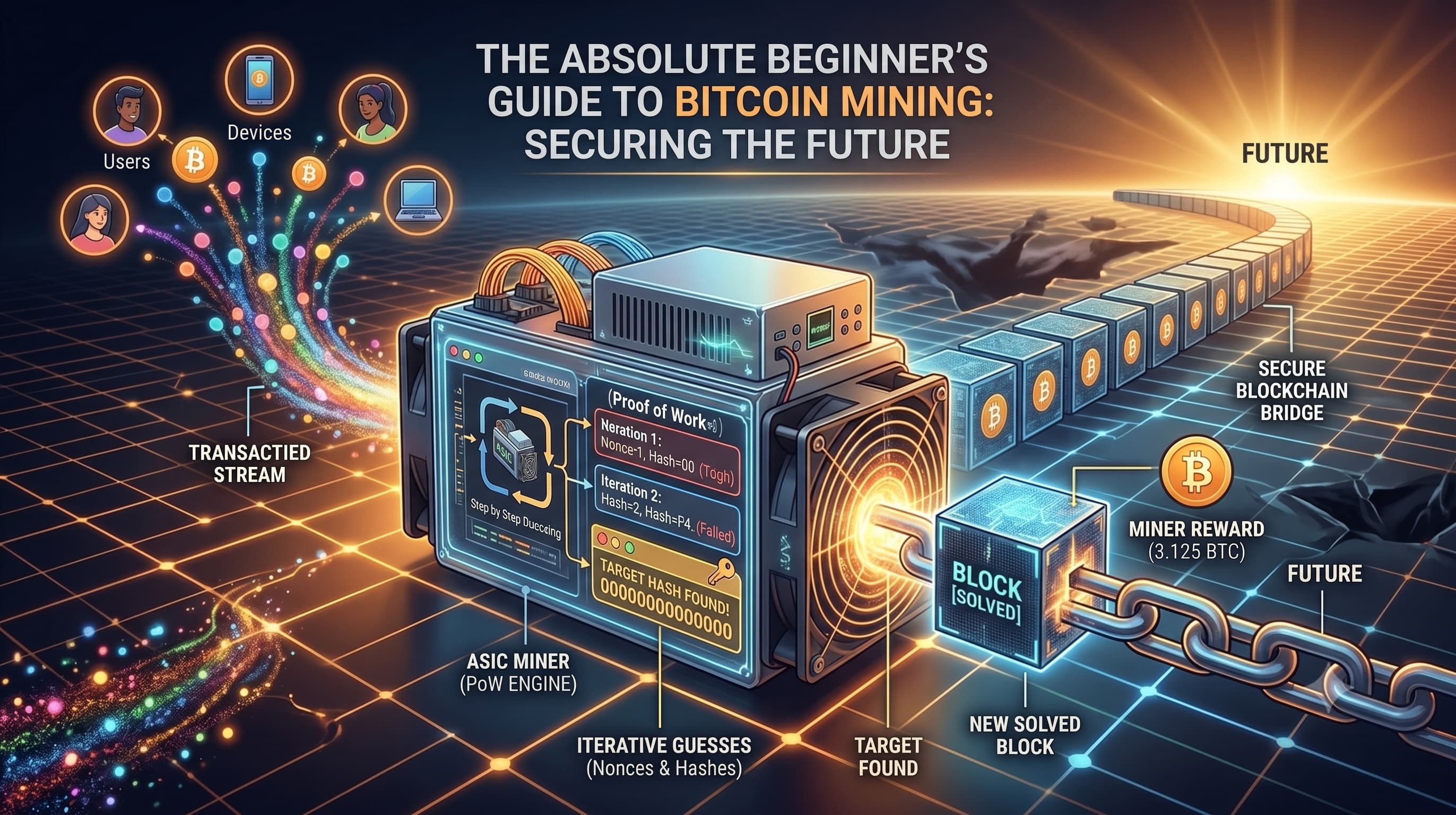
To incentivize miners to perform this necessary auditing work, the Bitcoin protocol introduces an economic competition based on computation (Wei et al., 2021). To successfully seal a new block and earn the associated reward, a miner must solve a complex mathematical problem known as a "Proof-of-Work" (PoW) (Mardiansyah & Sari, 2022).
This "puzzle" is essentially a guessing game.
Miners are given a string of digital data—representing the transactions in the candidate block and a link to the previous block (McGinn et al., 2016). Their goal is to adjust a single random variable (called a "nonce") and repeatedly guess that resulting string until it produces a specific digital fingerprint (called a "hash") (Alsindi & Lotti, 2021). This correct hash must possess specific characteristics, such as a set number of leading zeros (Mardiansyah & Sari, 2022).
The first miner on the entire network to find this fingerprint solves the block, broadcasts it to the network for verification, and receives the Block Subsidy (currently 3.125 BTC) plus Transaction Fees paid by users included in that block (Alsindi & Lotti, 2021).
Because this competition happens billions of times per second across the network, modern mining cannot be done on a standard home laptop. It requires specialized hardware called ASICs (Application-Specific Integrated Circuits)—computational athletes designed solely to generate these guesses as efficiently as possible (McGinn et al., 2016).
The Infrastructure Imperative
While securing ASICs is the entry point, your economic success as a miner depends on the infrastructure supporting that hardware. An expensive ASIC that is overheating or dropping offline is a depreciating asset generating zero revenue.
This is where professional hosting facilities differentiate themselves. An effective operation must solve the three primary engineering challenges of scaling Bitcoin infrastructure:
- Thermal Dynamics: High-efficiency ASICs operate at extreme densities, converting hundreds of megawatts of electricity directly into heat (Harvey-Buschel & Kisagun, 2016). Managing this thermal load requires rigorous air-cooled modeling or advanced immersion cooling layouts to ensure machines are not thermally throttled, reducing their output.
- Telemetry and Granularity: When deploying multiple units, basic "uptime" metrics are insufficient. True yield protection requires deep telemetry—real-time tracking of every hashboard's temperature, efficiency ratio (J/TH), and pool connection stability.
- Network Resilience: A miner is only profitable if its valid computational work (shares) reaches the mining pool on time. Facilities must prioritize enterprise-grade networking—including automated failover protocols to backup fiber or high-speed gateways—to eliminate costly network degradation and stale shares.
By prioritizing industrial-grade infrastructure and data transparency, professional hosting facilities turn Bitcoin mining from a speculative endeavor into a precise and measurable infrastructure service.